
Fort Lee, NJ buying guide / Compact footprints and building access
Desks, chairs and storage for a small Fort Lee office
For a small Fort Lee office, useful furniture is furniture you can work around. Compare used and new desks, office chairs, and storage by their space in use, not just their listed dimensions. This guide covers desk depth, chair clearance, multiuse pieces, and the access questions to resolve with your building before arranging delivery.
The short answer
Plan each workstation as desk plus chair zone, not desk alone. Choose worksurface depth for the work being done, use vertical or under-desk storage, and keep a clear path to the door. Before ordering, ask your building about elevator size, reservations, and move-in hours.
Plan the footprint, not just the furniture
A desk listed at a given width and depth uses more floor than that. A person needs room behind the desk to pull a chair out, sit down, and stand up, and that zone cannot overlap a walkway or a door swing. In small rooms, this chair zone is usually what runs out first.
Draw each desk with its chair zone attached. If two zones overlap, or a zone blocks the only path to the door, the layout will feel cramped no matter how attractive the furniture is.
When testing the chair zone, follow the hands-on office chair buying checklist to check working height, armrests, and movement at the desk.
Choose worksurface depth for the work
Shallower desks free up floor area, but they bring a monitor closer to your eyes and leave less room for paperwork. A laptop-only role can often use a shallower surface; a dual-monitor role usually needs more depth. Measure what will sit on the desk before deciding.
Corner and L-shaped desks can use a room corner efficiently, but they also widen the chair zone. In a narrow room, a straight desk on the long wall may leave more usable floor.
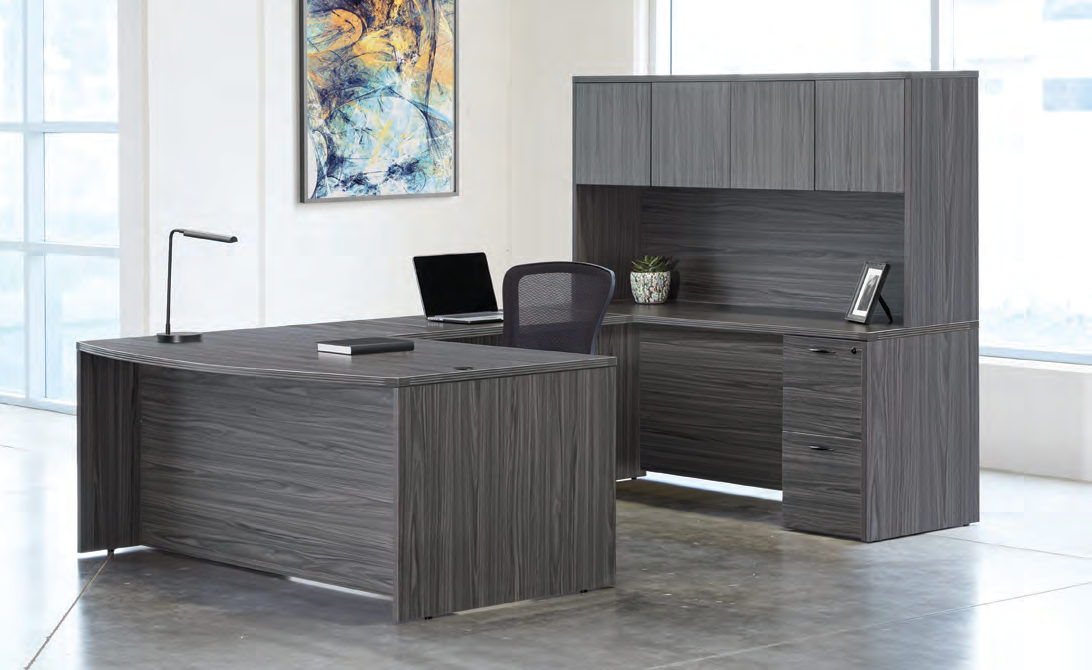 Catalog example
Store vertically and under the surface
In a small office, floor area is the scarcest resource. Mobile pedestals tuck under desks, tall storage uses wall height, and shelving above a desk keeps reference items close without spreading out.
Before choosing tall storage, check ceiling height, wall anchoring requirements, and whether the unit can pass through doors and the elevator. Ask your landlord whether anchoring to the wall is allowed.
Building-access questions to ask before ordering
Compact suites are often in larger buildings with shared elevators and management rules. These questions are easy to ask early and frustrating to discover on delivery day.
- What are the elevator door and cab dimensions, and is there a service elevator?
- Does the building require an elevator reservation, padding, or a staff escort for furniture moves?
- What hours are furniture moves allowed, and are weekend or after-hours moves required?
- Does management require a certificate of insurance from anyone delivering or installing furniture?
- Where can a delivery vehicle stop, and how far is it from the loading area to the suite?
Furniture that does two jobs
A small table can serve as a meeting spot and an occasional work surface if it supports both tasks comfortably. Nesting or stacking chairs may be useful when their stored footprint also fits the room. Use a storage pedestal as seating only when the manufacturer specifically rates that model for it; adding a cushion does not turn any cabinet into a chair.
With used furniture, resist buying a nearly suitable piece because it happens to be available. New furniture is also a poor choice if its configuration blocks movement. Keep the same fit checklist for both.
- Desks: Measure the space for monitors and keyboard use as well as the outside edges. Check return orientation and how far drawers extend into the chair zone.
- Task and guest chairs: Measure the actual arms and base, test adjustments on used models, and check whether a guest chair stores where you intend. A stacking label does not establish its stacked height or footprint.
- Vertical storage: Check door or drawer swing, safe access to shelves, and the model's anchoring instructions. Height saves floor area only if the cabinet can be delivered and used safely.
For a room that changes users or serves another purpose, see the Teaneck shared and home-workspace guide for adjustment and personal-storage questions.
Illustrative planning scenario
Planning scenario: two people in a narrow single-window office
Imagine a long, narrow office with one window on the short wall, the door on the opposite short wall, and a need for two workstations plus a place to meet one visitor.
- Test two straight desks along the long walls on the measured plan. Proceed only if chair-use zones and the route to the door remain clear.
- Use shallower worksurfaces for the laptop user and a deeper one for the dual-monitor user.
- Put a tall storage unit near the door wall and pedestals under each desk.
- Use the window end for a small round table that doubles as overflow work space.
- Confirm elevator cab size and building move hours before ordering the tall unit.
An illustrative layout exercise, not a real customer project.
Compact office measurements
Record these before comparing desks. Small rooms leave little margin for guesswork.
- Room length, width, and ceiling height
- Sets floor area and the limit for tall storage.
- Door swing and location
- The swing zone cannot hold a desk or chair.
- What sits on each desk
- Monitors and paperwork decide the depth you need.
- Elevator door and cab size
- Tall and long pieces must fit the cab.
- Building move-in rules and hours
- Affects scheduling and cost.
Local resource
Borough of Fort Lee: All About Fort Lee (opens in a new tab)
The borough's official overview is a starting point for municipal information if your office project involves more than furniture.
Buying furniture for Fort Lee: questions and answers
How much space does a desk really need in a compact Fort Lee office?
More than the desk itself. Plan the desk plus a chair zone behind it where a person can pull out, sit, and stand, and keep that zone clear of walkways and door swings. Measure the room and draw each desk with its chair zone before choosing sizes.
What building questions should I ask before ordering office furniture?
Ask about elevator door and cab size, whether a reservation or padding is required, allowed move hours, insurance certificate requirements, and where a delivery vehicle can stop. Share the answers when you discuss delivery with PI Office Furniture.
Is used furniture a good option for a small office?
It can be, because you can see the actual piece and its dimensions before buying. Measure carefully and inspect condition in person. Confirm current availability, price, and condition with PI Office Furniture.
Does PI Office Furniture have a Fort Lee showroom or deliver there?
Our showroom is at 325 Chestnut Avenue, Hackensack, NJ 07606, not a Fort Lee branch. We deliver throughout New Jersey and New York City, including Fort Lee. Contact the team to discuss your building's access requirements and order-specific arrangements.
What should I test when buying a used desk and chair for a small room?
Try the chair at the desk, including its armrests and the space needed to pull back. Check that a desk return faces the right direction and that drawers open without blocking the exit or your legs. Test chair height and recline controls. A smaller desk is not a better fit if it leaves too little room for your monitor, keyboard, or paperwork.
Can I use the catalog to check which small desks are in stock?
Use it to identify layouts and features to discuss, not to establish stock. The 2026 catalog examples are not used-inventory listings. Share a reference image or model name along with your maximum desk dimensions, then ask about actual used and new options. If matching pieces are unavailable, compare alternatives against the same room measurements rather than accepting a larger footprint.
How do I ask about furnishing a compact Fort Lee office?
Call or text (201) 362-7787 or email the team with the number of workstations, room dimensions, monitor setup, and storage needs. Note door swings and any building access rules you have confirmed. Include your delivery address and ask about current items that fit, along with charges, scheduling, and any installation needs. Do not plan around a catalog picture alone.